MediumProblem 13 of 36 in the system design series
Design a Rate Limiter: Distributed Throttling for a Busy API
A rate limiter is the gatekeeper that decides whether a caller may make one more request right now. When a client exceeds its allowance, the limiter turns the request away with a clear error instead of letting it reach the services behind the API. Public APIs, login pages, search boxes and payment endpoints all depend on this kind of guard to stay healthy and fair.
Interviewers like this problem because it looks tiny on the surface. Counting requests seems trivial until you notice that the count has to be shared by dozens of gateway machines, checked on every single call, and updated without races. The question quickly turns into a conversation about algorithms, atomicity, failure modes and placement.
The hard part is the combination of constraints. The limiter must be exact enough that a client cannot multiply its quota by hitting different servers, yet fast enough that nobody notices it is there. It also must never become the reason the whole API goes down. Balancing those three pressures is what this design is about.
This is an interview practice design for a Rate Limiter-like service, built from first principles. It is not a description of how Rate Limiter is actually built.
Functional Requirements
The core job is to cap how many calls a given caller can make within some period. The caller might be identified by a logged-in user ID, an API key issued to a partner, or simply an IP address for anonymous traffic. Supporting all three matters because each catches a different kind of abuse: a scraping script without an account shows up only by IP, while a partner integration misbehaving is best tracked by its key.
Excess requests should be rejected immediately with HTTP 429, not queued, because queueing would hold server resources for traffic we already decided not to serve. Limits also need to be data, not code. A free tier at 100 requests per minute and a paid tier at 10,000 should be adjustable by an operator without shipping a new build. Finally, good clients deserve feedback: headers that show remaining quota and a Retry-After value let them slow down gracefully. DDoS mitigation at the network layer and monthly billing quotas are separate concerns and stay out of scope.
Limit per client
Allow N requests per time window, per user, API key, or IP.
user · key · IP
Reject the excess
Requests over the limit get an error right away.
HTTP 429
Configurable rules
Different limits per endpoint and per plan, without a deploy.
free vs paid
Tell the client
Return remaining quota and when to retry.
Retry-After
- Out of scope today: network-level DDoS protection and monthly billing quotas
Non-Functional Requirements
Because the limiter sits in the path of every call, its own latency is a tax on the entire API. A budget of roughly a millisecond, and certainly under two, keeps that tax invisible. This one constraint rules out anything that needs a slow database lookup per request.
Accuracy across servers is the second pressure. If fifty gateway instances each kept a private counter, a determined client could spread traffic across them and receive fifty times its quota. The limit has to be global. Third, the limiter should fail open: when its backing store is unhealthy, letting traffic through briefly is far better than rejecting every customer. Losing rate limiting for a minute is an inconvenience; losing the API is an outage. Throughput completes the list, since the limiter handles the full request volume of the platform.
Tiny overhead
Adds only about a millisecond to each request.
< 2 ms
Accurate across servers
One limit, even with many gateway instances.
distributed
Fail open
If the limiter breaks, traffic keeps flowing.
availability first
High throughput
It sits in front of every single request.
1M requests / s
Scale Estimation
Assume a peak of about 1 million requests per second, all of which need a decision. Assume roughly 10 million active clients across users, keys and IPs. Each client needs only a small record, around 100 bytes, so the whole working set is about 1 GB. That fits comfortably in memory on a single machine.
Throughput is a different story. If one Redis shard handles roughly 100,000 operations per second, then 1 million checks per second calls for about 10 shards. The estimate therefore tells us where to spend design effort: storage is a non-issue, while per-request speed and making each check-and-update a single indivisible operation are the real problems to solve.
1million
Requests per second
peak · each one is checked
10million
Active clients
users, API keys, IPs
1GB
Counter memory
10M clients × 100 B
10shards
Redis shards
1M / s ÷ 100K ops per shard
Memory is tiny → the real challenge is speed and atomicity
Core Entities & API
Three entities carry the design. The client ID names who is being limited. A rule describes the limit that applies, such as a match on plan and endpoint plus a limit, a window and an algorithm. The token bucket is the live state for one client, recording how much allowance is left.
Internally the gateway calls something like POST /ratelimit/check with the client ID, the endpoint and an optional cost, and receives whether the call is allowed, the remaining quota and a reset time. The optional cost is useful when one expensive endpoint should consume several units at once. Externally, a rejected call such as GET /api/orders returns 429 with Retry-After: 2, which tells a polite client exactly how long to back off. Operators manage policies through PUT /rules/{id}, so a new plan or a tighter limit on a hot endpoint is a configuration change rather than a release.
Core entities
Client IDRuleToken bucket
API
- POST /ratelimit/check { client_id, endpoint, cost? }→ { allowed, remaining, reset }
- GET /api/orders (rejected)→ 429 · Retry-After: 2
- PUT /rules/{id} { match, limit, window, algorithm }→ 200 OK
High-Level Design
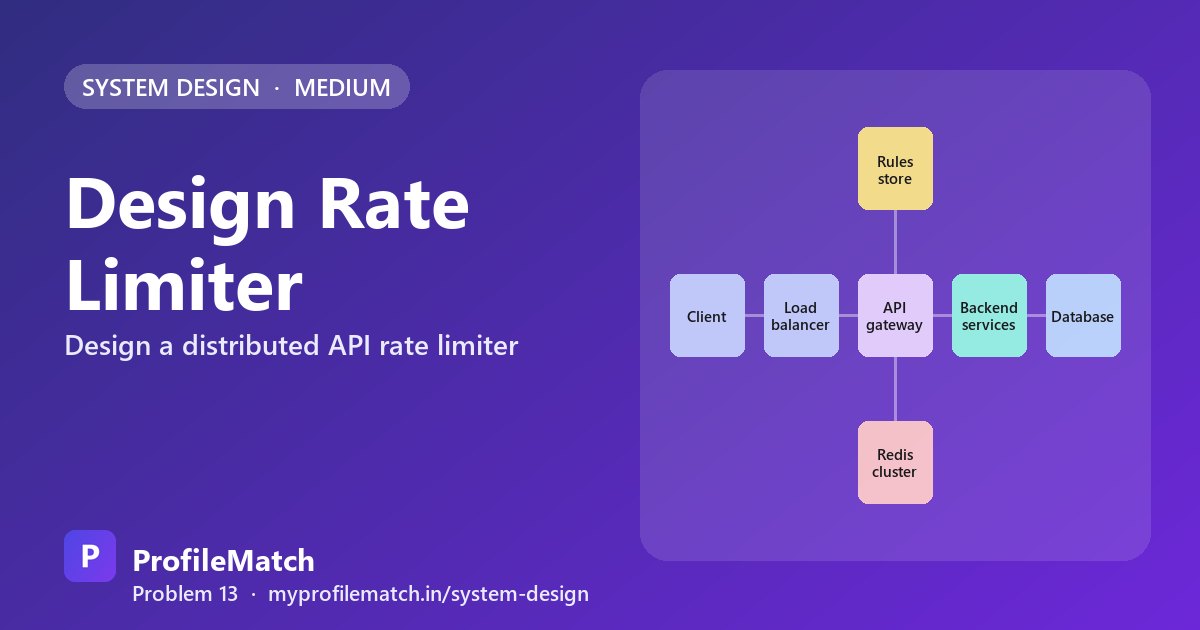
Traffic flows from clients through a load balancer into a pool of stateless API gateways. A throttling filter runs as the first step of request handling. The filter loads rules from a rules store once and keeps them cached in memory, refreshing periodically, so reading a policy costs nothing on the hot path.
For each request the filter makes one call to a Redis cluster that both checks and updates the client's bucket atomically. If allowance remains, the request continues to backend services such as orders or payments and on to their database. If not, the gateway answers 429 with a Retry-After header and the backend never sees the call. That is the payoff of placing the check up front: rejected traffic costs a single Redis round trip, not a database query.
The key decision is that counters live in shared Redis rather than inside each gateway. Every instance reads and writes the same bucket for a given client, so a caller gets one limit no matter how the load balancer spreads its requests.
Shared counters in Redis → one limit across every gateway
Deep Dive 1 — Which Algorithm
A fixed window counter is the simplest choice: count calls per minute and reset at the boundary. Its flaw is the edge. A client can spend its full allowance at 12:00:59 and again at 12:01:00, landing twice the intended rate in two seconds. A sliding window log fixes this by storing every request timestamp, but memory grows with traffic. A sliding window counter blends the current and previous windows cheaply, at the cost of being an estimate.
The token bucket wins here. Each client has a bucket with a capacity and a refill rate; each request spends a token. With a capacity of 10 and a refill of 1 token per second, a client can burst 10 calls after a quiet period but sustains only one per second over time. That matches how real apps behave, since page loads arrive in small bursts.
Refill is computed lazily. On each request we take the time since the last refill, multiply by the rate, add those tokens up to capacity, then spend one. No background timers run, and the state is just two numbers per client: tokens remaining and the last refill timestamp.
Fixed window
- + Simplest: one counter
- − 2× burst at window edges
Sliding window
- + Smooth, no edge bursts
- − Log: heavy on memory
- − Counter: approximate
Token bucketChosen
- + Allows short bursts
- + Just 2 numbers per client
- − Two settings to tune
- Capacity 10, refill 1 token / s → bursts of 10, 1 per second on average
- Lazy refill: tokens += elapsed × rate · no background timers
Deep Dive 2 — Atomic Counters
The danger with a shared counter is a read-then-write race. Two gateways read the same bucket showing one token, both decide to allow, and both write back zero. The client just got two requests for the price of one, and under heavy concurrency this leak grows large.
The fix starts with one Redis key per client and endpoint, for example rl:{client}:{endpoint}, holding the token count and last refill time. Rather than separate GET and SET calls, the gateway sends a small Lua script that reads the bucket, applies the refill, makes the decision and writes the result in a single call. Redis executes scripts one at a time, so no other command can slip between the read and the write. Atomicity comes from the execution model, with no distributed lock required.
Two housekeeping steps keep the system lean. Every key carries an expiry, so buckets for clients that go quiet disappear on their own and memory stays near the 1 GB estimate. Redis Cluster spreads keys by hash across the roughly 10 shards. If Redis becomes unreachable, the gateway fails open and applies a coarse in-process limit until the cluster recovers.
- 1Key per clientrl:{client}:{endpoint} → tokens, last_refill
- 2One Lua scriptRead, refill, decide and write in a single call
- 3Atomic in RedisScripts run one at a time: no race condition
- 4Set an expiryIdle buckets expire and free their memory
- 5Shard by keyRedis Cluster spreads clients across shards
- Redis unreachable? Fail open, with a rough local limit per gateway
Deep Dive 3 — Where to Place It
Client-side throttling is a courtesy, not a control. A well-written SDK can pace itself, but anyone can strip that logic out, so the server must never rely on it. The API gateway is the main enforcement point because it is one place that guards every service, and it rejects bad traffic before that traffic consumes any backend capacity.
Limits inside individual services still have a role. A service understands business cost, such as a report endpoint being far heavier than a profile lookup, but duplicating full limiter logic in every service is hard to maintain. The practical answer is layers: an edge proxy or web application firewall drops floods by IP, the gateway enforces per-user and per-plan quotas, and critical services keep a simple self-protection limit of their own as a last line of defence.
In the client: never trusted
Polite clients can throttle themselves, but anyone can bypass it.
At the API gateway: our main choice
One place for every service; bad traffic is rejected before it costs anything.
Inside each service
Knows business context, like the cost of a call, but repeats logic everywhere.
Layer it
Edge or WAF blocks floods by IP; gateway enforces plans; services protect themselves.
Trade-offs
Accuracy competes with latency. A shared Redis check gives a precise global count but adds a network hop; purely local counters are faster but drift as instances disagree. We accept the hop because a sub-millisecond call inside the same data center fits the budget. Fail open versus fail closed is a choice between availability and strictness, and for most APIs availability wins, with the understanding that limits briefly lapse during an outage.
The token bucket is cheap and tolerant of bursts, while a sliding window is smoother and stricter; pick the window if smooth traffic matters more than burst friendliness. Centralising at the gateway keeps rules in one place, but the gateway tier must scale with total traffic. The resulting design: token buckets, updated by atomic Lua in Redis, enforced at the gateway.
Accuracy vs latency
A shared Redis check is exact but adds a round trip; local counters are faster but drift.
Fail open vs fail closed
Fail open keeps the API up during an outage, but limits pause for a while.
Token bucket vs sliding window
Cheap and burst-friendly, versus smoother and stricter.
Central gateway
One place for the rules, but the gateway must scale with all traffic.
Token bucket. Atomic Lua in Redis. Enforce at the gateway.
Key takeaways
- Memory is small (about 1 GB for 10M clients); per-request speed and atomic updates are the real challenges.
- Token bucket: two numbers per client, lazy refill from elapsed time, bursts allowed up to capacity.
- Use one Lua script in Redis to read, refill, decide and write so concurrent gateways cannot race.
- Keep counters in shared Redis so every gateway enforces the same global limit for a client.
- Fail open with a rough local limit when Redis is down; availability beats strict limiting for most APIs.
- Layer enforcement: edge for IP floods, gateway for plan quotas, services for self-protection.
Interview questions
Which algorithm is best for an API rate limiter?
For most APIs the token bucket is a strong default. It stores only two values per client, the remaining tokens and the last refill time, and it allows short bursts while still enforcing an average rate. Fixed windows are simpler but let clients double their rate across a window boundary. Sliding window logs are precise but memory hungry, and sliding window counters are an approximation that works when slight inaccuracy is acceptable.
Why can't a rate limiter just GET and then SET a counter in Redis?
Separate GET and SET calls leave a gap where another gateway can read the same value. Two servers then both see quota available, both allow the request, and the limit is exceeded. Running the read, refill, decision and write inside one Lua script removes the gap, because Redis executes each script to completion before starting the next command, making the whole update atomic without locks.
What should a rate limiter do if Redis goes down?
Usually it should fail open, letting requests through rather than blocking every customer. To avoid being completely unprotected, each gateway can switch to a rough in-memory limit per client until Redis is healthy again. The local limit is not globally accurate, but it stops obvious floods. Systems where over-use is dangerous, such as login attempt limits, may choose to fail closed instead.
How does a client know when to retry after a 429 error?
The server returns HTTP 429 Too Many Requests with a Retry-After header giving the number of seconds to wait. Successful responses can also carry headers showing the limit, the remaining quota and the reset time, so a well-behaved client slows down before it is rejected. Clients should combine this with exponential backoff and jitter to avoid retrying in synchronized waves.
Where should rate limiting be implemented in a microservices architecture?
The API gateway is the primary place, because it covers every service and rejects excess traffic before it reaches any backend. Add an edge layer or firewall for crude per-IP flood protection, and let critical services keep a small self-protection limit. Client-side throttling is helpful for well-behaved callers but can never be trusted, since anyone can bypass it.
Keep practising
- Learn the building blocks in the free system design course.
- Rehearse answers with system design interview questions.
- See which open jobs fit your skills: upload your resume.